
Read Monroe County Deed Instruments
A recorded deed in Monroe County names the grantor, the grantee, and the legal description. Recording details and the form of conveyance appear on the same instrument, which sets a deed apart from papers that merely secure debt or assert a competing claim.
| Deed Type | What It Does | Common Use |
|---|---|---|
| Warranty deed | Conveys the described interest with stated covenants | Ordinary arm's-length transfers |
| Quitclaim deed | Conveys whatever interest the grantor possesses | Family, estate, or corrective transfers |
| Trustee or representative deed | Transfers through a trust or estate capacity | Trust administration and probate |
| Land contract or related deed | Documents vendor-vendee interests or later conveyance | Installment arrangements |
| Tax-foreclosure deed | Records a conveyance following the statutory process | Delinquent-tax property |
A mortgage is not ownership. It only evidences secured debt. So the mortgagee holds no title to the Monroe County parcel. An assignment moves a loan between holders; a discharge records its release. A lis pendens signals pending litigation without deciding title. So read the indexed document type before concluding anything.
Search Monroe County Deed Fields
The county deed-search page splits remote access by need. Tapestry EON suits occasional searches at a per-name fee, Laredo serves frequent work by subscription, and EON offers several paths around spelling and indexing problems. Visit the county deed-search page to choose between them.
| Search field | Purpose | Useful constraint |
|---|---|---|
| Party first/last name | Find grantor or grantee entries | Use % as a wildcard, including for an apostrophe |
| Document number/type | Target an instrument | Separate deeds from mortgages and releases |
| Begin/end date | Control the search period | Narrow broad names and avoid the 300-result cap |
| Subdivision, lot, block | Find platted property | Subdivision is required with lot/block |
| Parcel, tract, book/page | Match a known reference | Preserve county formatting |
| Section, township, range, quarter | Find rural legal land | Useful when no street address appears |
One instrument can generate several duplicate-looking rows. Compare document number, recording date, and legal description in Monroe County records before paying for another image.
See Monroe County Remote Deed Access
The Register's current access page explains EON, Laredo, and Monroe County date coverage.
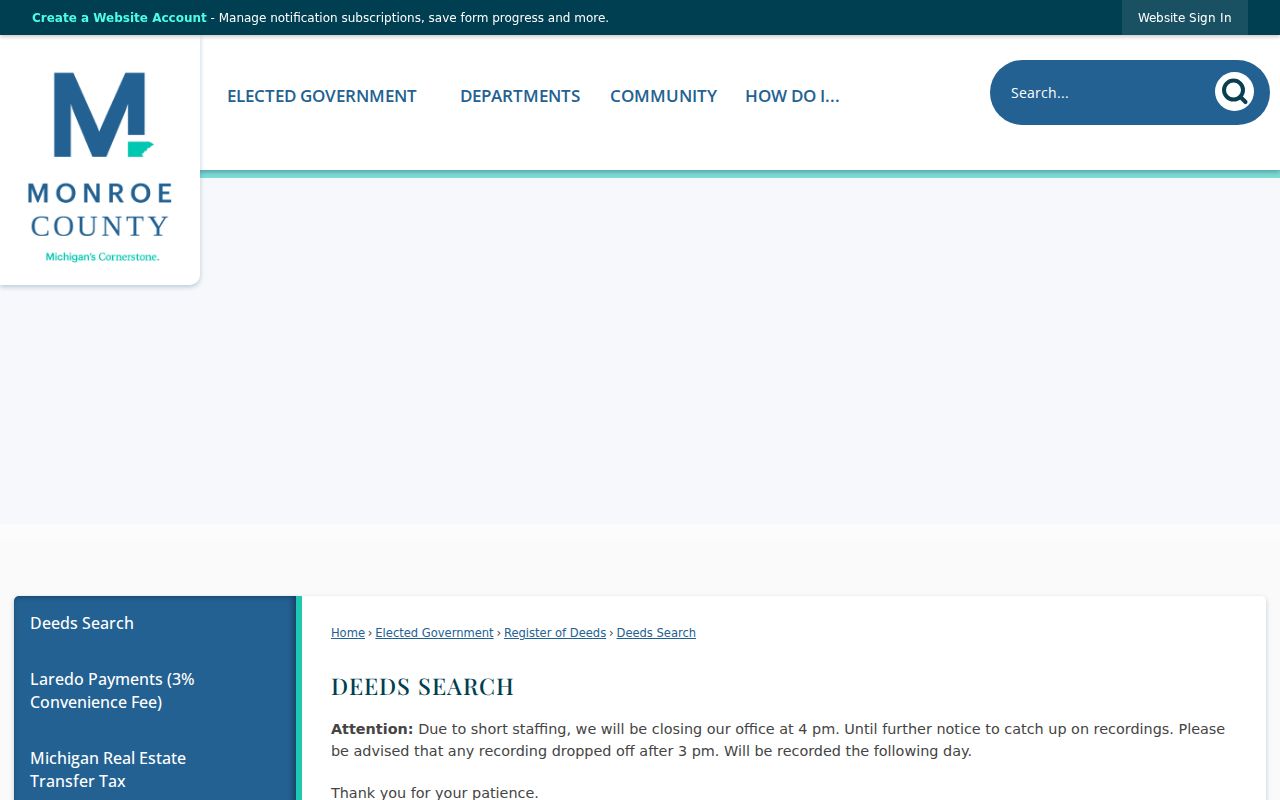
The current Register page controls. An older form may cite a different date for Monroe County deed coverage, so confirm unusual older references with the Register.
Walk Monroe County Grantor-Grantee Chain
Start with the newest credible deed. The assessment name alone is not enough. Grantees receive, grantors transfer, and each prior grantor becomes the next name to chase as an earlier grantee in the Monroe County chain.
- Find the newest conveyance and verify its parcel or legal description.
- Copy the grantor, grantee, deed type, recording date, and instrument or book/page reference.
- Search that grantor as a grantee in the earlier period and repeat.
- Branch into probate, court, tax-foreclosure, plat, or land-division records when the chain changes form.
- Move to the counter and historical books when the electronic index ends.
- Grantor
- The party transferring an interest.
- Grantee
- The party receiving an interest.
- Chain of title
- The connected sequence of conveyances for the same land.
- Book/page or instrument number
- The recorded locator needed to retrieve the document.
Know Monroe County Deed Cutoffs
Dates matter here. The current Register page puts remote and in-house Monroe County records at 1976 forward. The online name index begins January 1, 1981. So a late-1970s deed can exist yet defeat a party-name search. An older Laredo form claims 1990. That makes the live county page the statement to trust and the Register the office to ask about an uncertain year.
Earlier decades live in deed books and historical collections. The Library of Michigan Monroe guide identifies Libers A, B, and C. They cover March 21, 1806 through May 21, 1818. Those books hold early deeds and some wills. That mix makes them unusually valuable when a Monroe County land history crosses into probate.
Note: A missing name-index hit before 1981 does not establish that no recorded conveyance exists.
Use the EON Result Screen Deliberately
The Tapestry EON search exposes party, date, document, parcel, subdivision, and legal-land criteria.

Broad fields explain why one failed name search should never end the effort. Retry with parcel data, subdivision, book and page, or section-township-range details instead. Each added criterion narrows results toward the true deed record. The official Tapestry guide also demonstrates result and image-access behavior.
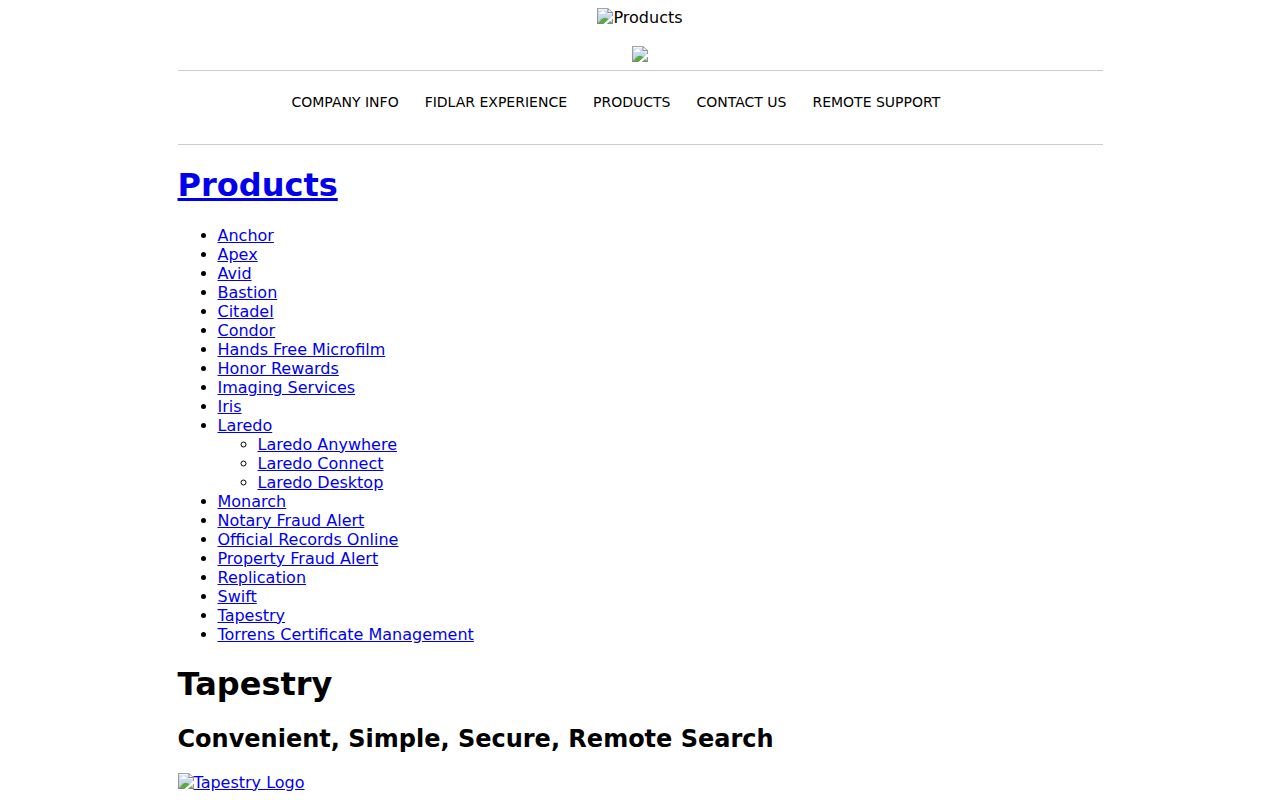
Copy the document number first, since several Monroe County rows can represent parties to one instrument.
Understand Current Search and Copy Costs
The county currently advertises EON at $8.75 for each party-name search. That figure changes to $8.95 on July 1, 2026. Printed image pages add $1 each. That date makes this a fee to recheck before relying on it. Laredo works on subscription minute plans and also charges $1 per page. Walk-in print-only access runs $1 per page.
The Register's published fee schedule lists ordinary copies at $1 per page. Certification adds $5. One warning deserves attention. The county flags a private deed-service solicitation asking about $83 as not county-affiliated. Call 734-240-7390 when a certified copy, older instrument, or fee quote matters.
Recording Rules Explain Some Missing Deeds
The county's recording requirements cite MCL 565.201. For instruments recorded after October 29, 1937, names must be printed or stamped beneath signatures, names and titles must agree throughout, and acknowledgments must match. Original grantor signatures are required. An easement grantor must be the owner.
The transfer-tax guidance requires stated consideration or a Real Estate Transfer Valuation Affidavit, plus documentary tax unless an exemption applies. The seller or grantor generally pays. A multi-county conveyance allocates value county by county, and a paper that was rejected or never presented never becomes a recorded Monroe County deed.
Follow Monroe County Deed Encumbrances
Encumbrances demand their own search. Check mortgages near the acquisition deed. Then chase later assignments, modifications, and discharges. An encumbrance may have been indexed right around the transfer date. So search both current and prior Monroe County owners. A land contract names vendor and vendee interests. But it is not fee ownership without the later deed or legal analysis.
State and federal lien searches carry their own certificate fees. The county never treats a name-only result as a title opinion. Match everything. Debtor identity, parcel description, recording date, release, and later documents must line up. Municipal easement or site-plan files add context. Even so, a permit creates no recorded title.
Monitor Monroe County Deed Filings
The Register offers Monroe County Property Fraud Alert monitoring for names and parcels.
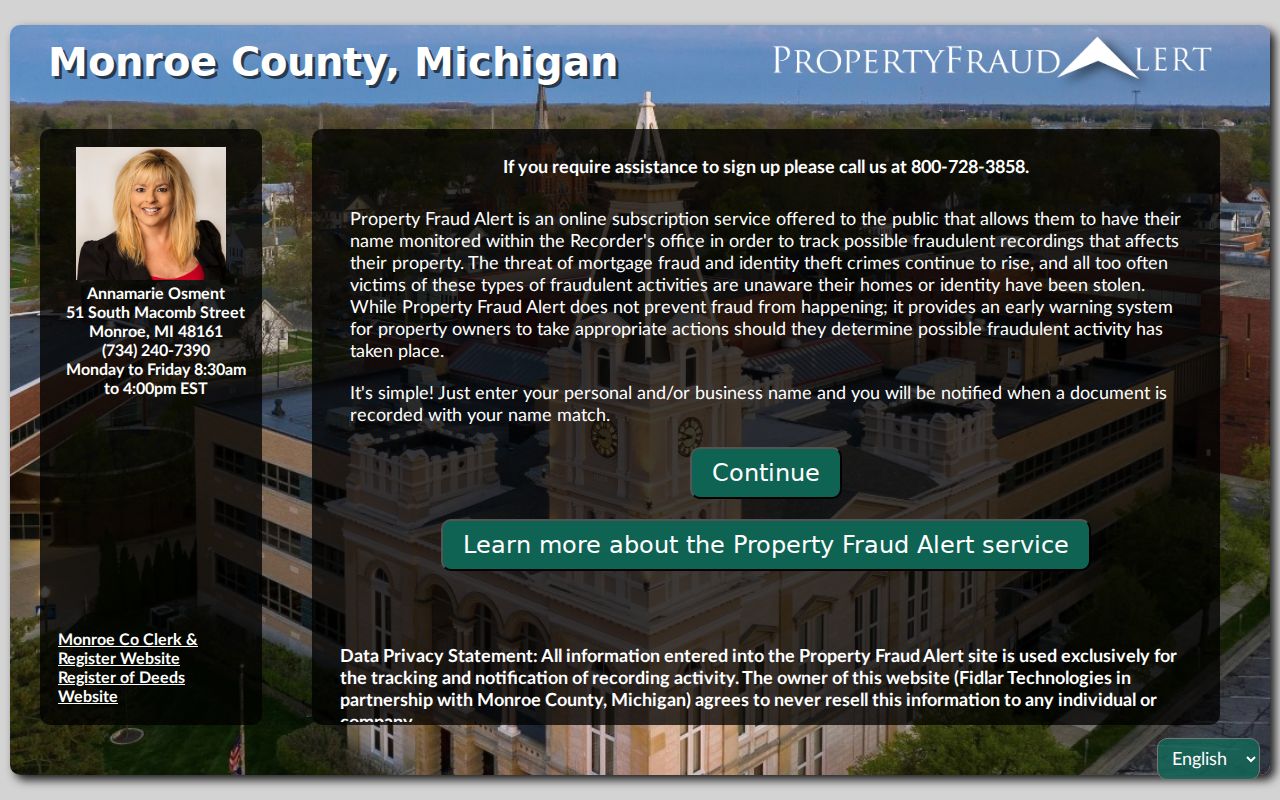
An alert invites a quick look. It cannot stop recording, insure title, or decide validity, so treat it as a prompt to inspect the newly indexed Monroe County instrument.
Request a Monroe County Deed Copy
The Register of Deeds keeps the official deed records for Monroe County. The office sits at 51 S Macomb Street, Monroe, MI 48161. Walk-in service runs Monday through Friday, 8:30 a.m. to 4:00 p.m. The office does not close over lunch. Deeds that arrive after 3:00 p.m. are recorded the next business day. Phone, mail, fax, and counter requests all work when the online image falls short.
Do you want a plain copy or a certified copy? Either way, give the office enough detail to find the deed. Party names, the parcel number or legal description, instrument type, and the date range all help narrow the search. A book and page reference speeds things up even more. For older books, certified copies, and anything unusual, staff handle the request directly. The Library of Michigan, the Archives of Michigan, the Monroe County Library System, and FamilySearch access at a library offer historical deed records. These serve as backups.
Recorded, not guaranteed. The index shows instruments accepted for recording. It does not resolve unrecorded interests, legal effect, priority, or clear title.