
Compare Monroe County Property Value Fields
Michigan assessment records split valuation into distinct ideas. Assessed value sits at 50 percent of true cash value under state law. SEV is the assessed figure after equalization. Taxable value behaves differently. Proposal A caps it, and it can uncap after a transfer, so taxable value may sit far below SEV.
| Value | What It Is | Where |
|---|---|---|
| Assessed value | One-half of the assessor's true cash value estimate before equalization | Local assessment roll and BS&A |
| State equalized value | Assessed value after county and state equalization controls | Assessment roll and Equalization reports |
| Taxable value | The capped or uncapped base used with millage to calculate tax | Assessment and tax record |
| Last sale or consideration | A transaction amount or valuation clue associated with a recorded transfer | Deed, valuation affidavit where applicable, and assessor sale fields |
Doubling assessed value is not a parcel appraisal. It only approximates the assessor's true cash value premise. Equalization ratios measure assessment levels across property classes and taxing units. A countywide multiplier says nothing about what one house will fetch, and it is not taxable value either.
Compare SEV and Taxable Value
SEV is equalized assessment. Taxable value runs under the Proposal A cap. A transfer of ownership triggers uncapping under MCL 211.27a. This generally happens in the calendar year after the deed changes hands. That timing explains why two similar Monroe County parcels can carry different taxable values. Their SEVs may still sit close together.
A Property Transfer Affidavit tells the assessor a transfer occurred. Log the transfer date, assessment year, SEV, taxable value, and any exemptions in separate columns. Then compare years cleanly. A taxable-value jump is not proof of improvement. First check whether ownership changed or the assessor corrected the roll.
Look Up a Monroe County Assessed Value
The official BS&A hub starts simple. You pick a state and municipality, then search by address, name, or exact parcel number. Pick Assessing or All records. A city mailing name may not identify the legal assessment unit, and a blank result often yields to a shorter street string, an exact parcel format, or the right township.
- Open BS&A and select the municipality that actually assesses the parcel.
- Search the situs address; if needed, retry the exact parcel/reference number.
- Record the assessment year, assessed value, SEV, taxable value, class, and exemptions displayed.
- Preserve last-sale or transfer fields only as shown, then compare them with the recorded deed.
- Note the search date because GIS, assessment, and recorded-transfer sources refresh on different schedules.
- Assessed value
- The local assessor's statutory half-value assessment before equalization.
- True cash value
- Michigan's market-value concept used as the base for the 50 percent assessment rule.
- Taxable value
- The capped or uncapped figure to which tax rates apply; it is not another name for assessed value.
- Sale consideration
- The amount or value stated for a transfer, subject to deed and valuation-affidavit context.
- Equalization
- The county and state process that brings assessment levels to the required standard across classes and units.
Reading the Monroe County BS&A Value Record
BS&A List View shows Name, Reference number, and Address. Detail View may add summary value and building information. Property and Tax tabs appear depending on the municipality. The official guide does not promise identical fields for every Monroe County city and township, so a missing tab is not proof that no record exists. Open the Monroe County BS&A municipality hub to see the official entry point.
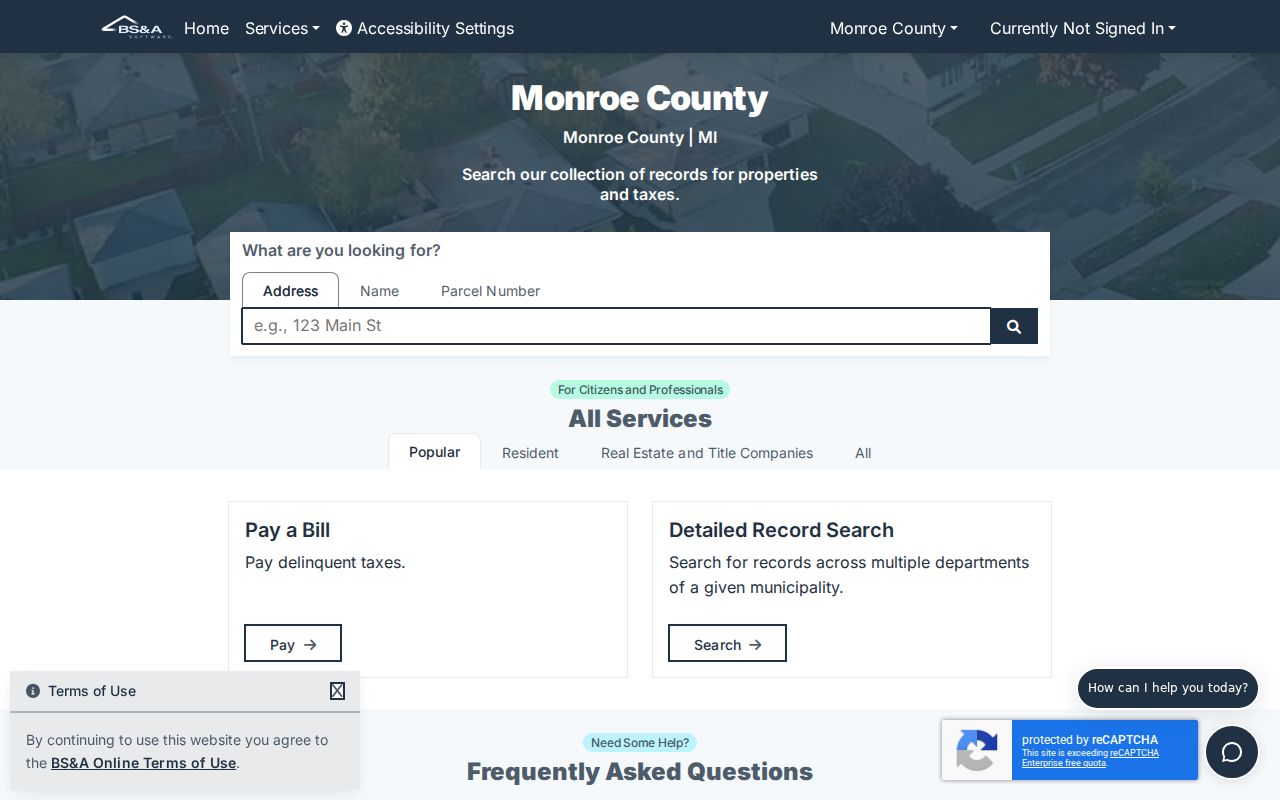
The hub supplies the search route. The municipality you select controls which parcel fields appear and which local office can explain them.
Recorded Sales Show Another Monroe County Value
A deed records a conveyance, not a present appraisal. Monroe County requires consideration or a Real Estate Transfer Valuation Affidavit in the applicable recording workflow. Transfer tax reaches more than ordinary sales. Foreclosures, easements, rights-of-way, family transfers, and partial-interest deeds can each leave a consideration figure that is not a clean arms-length comparable.
The City of Monroe publishes a property-sales resource. It helps place a transaction in local context. Review the official Monroe property sales page before you interpret a city sale record.

The city source supports sale research for Monroe parcels. Other municipalities may expose different fields or require a request to the local assessor.
Equalization Adds Countywide Value Context
The 2024 Monroe County Equalization Report analyzed about 6,777 deeds recorded in 2023. County equalized value hit $9,823,891,990. That was up $787,362,721 from the prior year, with the 19 taxing units at ratios between 49 and 50 percent. These studies shape equalization. They never supply a value for one parcel.
The 2025 and 2026 reports continue class, ratio, and multiplier reporting. Use the report for the assessment environment. Use the parcel card for the actual value. Label the tax year, class, municipality, and county source, so a Milan result from Washtenaw County never mixes into Monroe County data.
Date Monroe County Property Values Carefully
Portal update schedules are not all the same. Property Data Exchange metadata says the GIS item was updated July 23, 2026 and reviewed weekly. The Interactive Parcel App updates assessment information biannually. It credits that data to local assessors. A weekly map review does not mean a newly recorded deed has already moved the assessment roll.
Track four dates when a transfer is recent: deed signing, recording, assessment effective year, and portal search date. Monroe County sets no fixed countywide deed-to-roll lag. Ask the local assessor whether the transfer has been processed if the seller's name or an older taxable value still shows.
Exemptions Change Tax Treatment, Not Market Price
A Principal Residence Exemption can strip up to 18 mills of local school operating tax from a Monroe County tax bill. That relief is real money. It does not touch the assessor's estimate of true cash value, though. Disabled-veteran and poverty exemptions work the same way. Each follows its own eligibility rules. None of them discounts what a parcel would fetch on the open market. For valuation work, note whether an exemption field appears on the record. Keep it apart from SEV and taxable value.
Questions about a tax bill or an exemption claim go to the local assessor. So do appeals. Monroe County property tax records guidance covers that side of the ledger in more detail: Monroe County property tax records guidance.
Know Monroe County Property Value Limits
Monroe County assessment works as a mass valuation built for public taxation. That scale leaves gaps. No assessor can price a home's odd condition, private repairs, or the financing terms behind a sale. An assessor also cannot weigh every feature a buyer might. A recorded sale price reports a past event. The SEV is a tax-system estimate tied to an assessment year. Even close figures answer different questions about the same parcel in the Monroe County property records.
Value is not price. A Monroe County assessed value supports taxation and is not a prediction of sale price or a parcel-specific appraisal.